
To put this post in context, 2026 is a Congressional election year, and the Trump Administration is trying to keep the Republicans in charge so it can continue to spend hundreds of billions of dollars on the military-industrial complex to wage war against Iran and assist in its ally Israel’s Palestinian genocide. Knowing that it was Robert F. Kennedy, Jr.’s Make America Healthy Again voters who got Trump elected in 2024, it’s time to pander a bit. That’s why we’re seeing an executive order on childhood vaccines and Health & Human Services Secretary Kennedy take action to stop corporation’s secretive use of a food safety loophole known as "GRAS” (generally recognized as safe).
As always, it’s too little too late. After the midterms, RFK Jr. will likely admit as much. He’ll probably quit the Trump Administration and start campaigning for president again. He’ll have to disavow everything that’s happened over the last two years and explain why he couldn’t do any of the things he should have done, like revoke all the PREP Act declarations (instead of writing new ones—hantavirus). People will believe his mea culpa and look past obvious red-flags like what Sec. Kennedy has done to deregulate Ai in medicine as his son Finn works with Palantir co-founder Joe Lonsdale to replace doctors with bots. They’ll get duped into voting for the next person he supports for president (Tulsi Gabbard?) just like they did with Trump. Or, he’ll take a third-party candidacy all the way to the finish line only to be the spoiler who gets the Democrat (Liz Cheney?) elected.
That’s the political context. Here’s the technology context:
Genetically modified organisms (GMOs) have been used to produce our food for more than thirty years. The technology has progresses to the point where genetic engineers are designing DNA on computers and inserting synthetic DNA into microbes. In the near future, synthetic biologists might build their cell factories from scratch. A recent experiment that created bare-bones cell suggests that manufacturing wholly synthetic cells could be possible one day.
This summer, Biotic engineers unveiled SpudCell, the first synthetic cell built entirely from non-living molecules that can feed, grow, and divide. It isn’t alive, and it isn’t anywhere near your grocery store. But it may be what’s next for snybio food.
Synthetic cells are only being created now, so it’s too soon to say how they’ll be used, but Biotic’s motto is ex uno plures (from one many) and its cofounder Drew Endy includes food in his vision:
Biotechnology goods and services already account for ~5% of the United States’ economy; foods, fuels, materials, and medicines are the major product categories.
Up to “60% of the physical inputs to the global economy” could be made via biotechnology by mid-century, generating ~$30 trillion annually in mostly-new economic activity. Emerging product categories include consumer biologics (e.g., bioluminescent petunias, purple tomatoes, and hangover probiotics, military hard power (e.g., brewing energetics), mycological manufacturing (e.g., mushroom ‘leather’), and biotechnology for technology (e.g., DNA for archival data storage). Accessing future product categories will depend on unlocking biology as a general purpose technology (e.g., growing computers), deploying pervasive and embedded biotechnologies within, on, and around us (e.g. smart blood, skin vaccines, and surveillance mucus), and life-beyond lineage (e.g., biosecurity at birth, species de-extinction).
Endy listed additional examples for a New York Times profile, “Can Synthetic Biology Save Us? This Scientist Thinks So.”:
The product developers, which include organizations from tiny start-ups to pharma giants, are developing products and new manufacturing processes with synthetic biology across the spectrum of industry. Synthetic biology, for example, was employed to accelerate the production of Covid-19 vaccines.
Not every application aims to save lives or the planet. Cronos, a Canadian company, is using synthetic biology to develop cannabis edibles. Zbiotics, a San Francisco start-up, has a hangover killer.
But there are elements of the potential Mr. Endy sees for transformation of major industries. Bayer, whose agricultural interests include the DEKALB seed business, is creating nitrogen-fixing microbes to apply to seeds, potentially reducing the use of chemical fertilizer.
Lululemon, the athleisure wear maker, is working with a start-up, Genomatica, to shift from petrochemical-based nylon to bio-built fabrics. Impossible Foods uses synthetic biology to create its plant-based burgers. Bridgestone is exploring the use of bio-based alternatives for chemical polymers used in producing tires. And Amyris, an early synthetic biology company, has become a thriving supplier of ingredients for the cosmetics and fragrance industry.
Federal regulators are doing nothing to keep SpudCell from following earlier synbio technologies into our food without review through a gap in Food and Drug Administration regulations known as GRAS.
In 1958, Congress passed the Food Additives Amendment, which requires new food ingredients to undergo rigorous safety testing before they can be sold. Somehow, every lab-engineered Frankenfood to hit the market has avoided that. That’s because, the Food & Drug Administration let the products of genetic engineering, nanotechnology, and novel microorganisms, evade regulation through an exception to the food additives law known as “generally recognized as safe” or by its acronym GRAS. The FDA opened the loophole so wide that nothing ever undergoes premarket safety testing.
GRAS is a failed process that lets companies claim that new synthetic Frankenfoods are exempt from pre-market safety testing. Even this is voluntary! Under the loophole, all a company has to do is decide, on its own, that its novel ingredient is GRAS. As things stand now, the company doesn’t even have to tell the FDA it has done so. This means we have no way to find out what new synthetic Frankenfoods are entering the food supply or what the risks of eating them might be. That’s the secrecy Sec. Kennedy is trying to make transparent.
When companies do file a voluntary notice, the agency’s typical response is a “no questions” letter, which sounds like approval but means only that the FDA has no further questions about the company’s own GRAS determination. Food-safety lawyers argue this arrangement violates the 1958 law, but they have not yet won that argument in court.
Sec. Kennedy efforts may one day produce a reliable public record of GRAS ingredients, but otherwise things would stay the same: a big, blind experiment where we’re the test subjects.
We must continue to demand what has never been done in thirty years of genetic engineering and synthetic biology: independent, mandatory safety reviews, honest labels, and regulations that can protect us even after FDA-approved Frankenfoods hit the market.
Until the federal government starts doing that, all we can do is to hope state legislators will keep this stuff out of stores and restaurants. Several states have taken action to ban lab-grown (cell-cultured) meat, but most of the synbio industry’s Frankenfoods are slipping past them.
Here’s what state lawmakers need to know:
These aren’t first-generation GMOs. Today, instead of modifying microorganisms with natural genes extracted from other organisms (like Monsanto’s rBGH), they use synthetic DNA to “program” the cells.
Food made with GMO microbes may be toxic or trigger allergies. Back in the 1980s when Showa Denko decided to produce its tryptophan supplement with genetically engineered bacteria, 37 people died and 1500 were permanently disabled.
These GMOs are completely unregulated. The Food and Drug Administration lets synbio GMOs enter our food through the its “Generally Recognized as Safe” (GRAS) loophole.
There’s no safety review. Companies simply declare their own products GRAS, and even that is voluntary. Food-safety lawyers argue this violates the 1958 Food Additives Law, but they haven’t won that fight in court.
There are no labels. People have no idea that genetically engineered microbes are being used to create synthetic “foods” or what the risks of this might be. Consumers aren’t asked if they want to eat this stuff—it’s all entering the food supply unlabeled.
State laws to ban lab-grown (cell-cultured) meat are missing most of the synbio industry’s Frankenfoods. State legislators have let the lab-grown chocolate created by Celleste for Mondelez slip by them. They’ve also failed to catch precision fermentation, an extreme form of genetic engineering where artificial DNA is inserted into microbes to produce synthetic proteins and unique molecules unknown to nature. While lab-grown meat has proven too expensive to commercialize, products of precision fermentation, including fake blood, imitation egg-whites, and synthetic whey protein already being sold in stores and restaurants.
Sec. Kennedy may succeed in making corporation’s use of the GRAS loophole more transparent, but he isn’t doing anything to close it or even tighten it up.
Food From Microbes—The Hundred-Year Plot to Replace Real Farms with Fake Food
The plot to replace real farms with fake food was launched a century ago. In 1931, future Prime Minister Winston Churchill, advised by eugenicist Frederick Lindemann, penned “Fifty Years Hence,” in which he wrote:
Microbes, which at present convert the nitrogen of the air into the proteins by which animals live, will be fostered and made to work under controlled conditions, just as yeast is now. New strains of microbes will be developed and made to do a great deal of our chemistry for us.
With a greater knowledge of what are called hormones, i.e. the chemical messengers in our blood, it will be possible to control growth. We shall escape the absurdity of growing a whole chicken in order to eat the breast or wing, by growing these parts separately under a suitable medium. … The new foods will from the outset be practically indistinguishable from the natural products, and any changes will be so gradual as to escape observation.
With their evil genius, the agriculture cartels have figured out that the best way to drive farmers out of business is by getting rich doing it. As long as there’s a farmer left on earth, companies like Monsanto (now Bayer) will keep them in debt slavery making them buy expensive—and toxic—inputs.
Industrial production with huge capital investments and expensive genetically engineered seeds, pesticides, and fertilizers, has always meant high costs for farmers and low prices paid to them, but the farmers are hooked. When there are fertilizer shortages, they protest for the privilege to keep buying over-priced polluting synthetic inputs from monopolistic cartels like junkies begging their dealers for a fix.
When farmers go out of business, that does no harm to agribusiness. With every bankruptcy, the land just gets consolidated into larger farms. This consolidation increases profits, and anyway, as the quote from Churchill proves, they’ve long had a plan for a world without farmers, farms, or food.
New genetically engineered synthetic Frankenfoods that contain no ingredients grown on farms are already being sold in stores and restaurants. They’re different from the first wave of genetically modified organisms, Monsanto’s Roundup Ready crops that were tweaked with bacterial DNA that made them impervious to the herbicides that would normally kill them.
Roundup Ready GMOs grow from seed like normal crops. They look and taste like regular corn, soy, canola, etc. (even though they contain proteins human beings had never eaten before).
The new GMOs are 100% synthetic. Instead of growing in living plants, they are spit out of fungal microbes or genetically engineered yeast or E. coli. Instead of having foreign DNA from another living organism, their molecules and DNA might be totally unique structures not found in nature.
In not-so-distant future only rich people will eat real food. As the Amazon Prime Video sci-fi series Upload showed us, for the rest of us poor schmucks, “food” will come off the 3D printer. In Upload Season 1 Episode 6, “The Sleepover” (2020), a girl eats dinner at a rich family’s home and gets laughed for being surprised to learn that chicken has bones—she’s only ever eaten 3D printed food. Science fiction? Not for World Economic Forum corporations like Bayer (Monsanto).
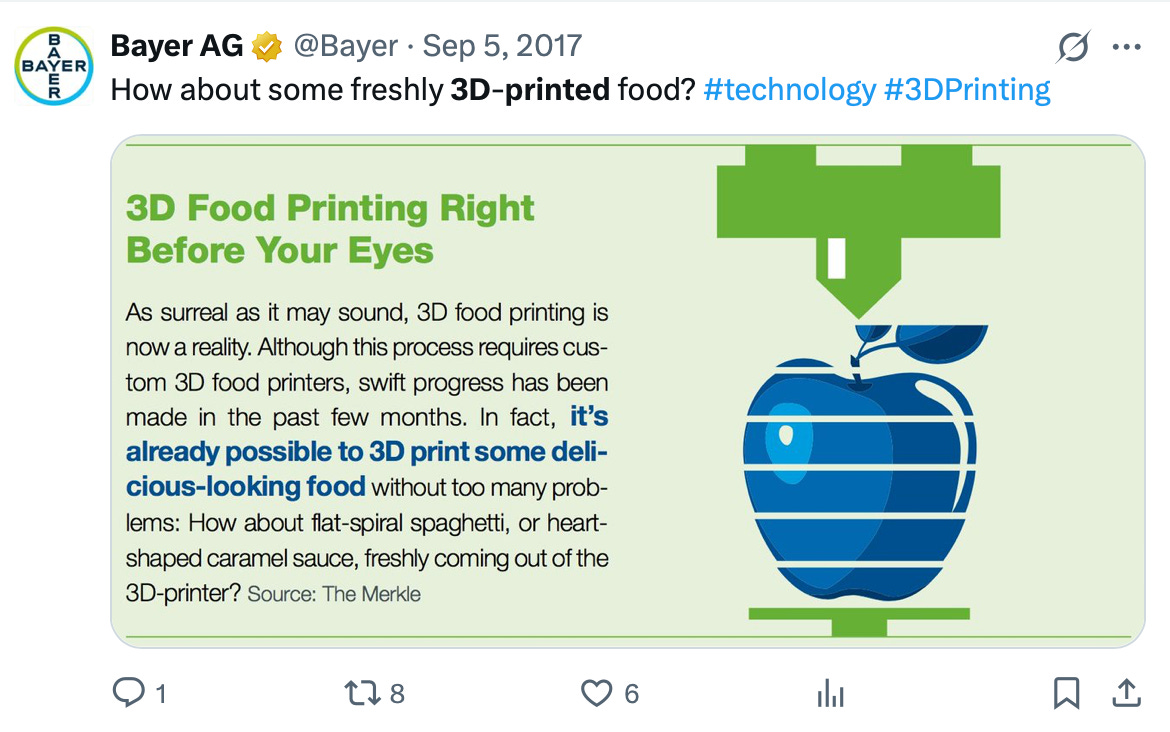
Back in 2017, Bayer tweeted, “As surreal as it sounds, 3D food printing is now a reality. Although this process requires custom 3D food printers, swift progress has been made in the past few months. In fact, it’s already possible to 3D print some delicious looking food without too many problems.”
Bayer has been working with Natural Machines, maker of the Foodini, a home 3D-printing kitchen appliance, to create 3D-printed food. Unfortunately, the video of a talk by Natural Machine’s Emilio Sepulveda at the U.S. Chamber Foundation 2017 Food Forward program sponsored by Bayer where he promoted the idea of using food waste (animal as well as vegetable) to make 3D-printed food, is no longer available.

What will Bayer’s 3-D printed food be made from? Probably a genetically engineered or whole synthetic microbe, either a protein or other small molecule that the microbe spits out or a mold grown of the microbe itself. What follows is an incomplete list of Frankenfoods from microbes that have improperly entered the food supply as GRAS.
Quorn & Other “Mycoproteins”—Never Safety Tested, Not Here or in the E.U
In the early 1960s, the British industrialist J. Arthur Rank (Lord Rank), Chairman of the Rank Hovis McDougall group of companies (RHM) was looking for something that could be done with the starch that was the main waste product of his flour-milling business. He tasked his research director, Dr Arnold Spicer, with investigating the feasibility of turning the starch into protein using microbial fermentation.
Dr. Spicer zeroed in on fungal microorganisms. With their filamentous cell structures, they could grow into molds with a texture that would be good for imitation meat.
By 1967, Dr. Spicer had tested 3,000 organisms taken from soil samples around the world and selected Fusarium venenatum. Venenatum, inauspiciously, is Latin for “filled with venom.”
That’s the origin story of the meat alternative sold under the brandname Quorn, a so-called “mycoprotein,” a vat-fermented mold excreted by a fungal microbe fed on glucose from corn starch. Molds like Quorn are also known as “fungal biomass” or products of “biomass fermentation.” Instead of the GMO microbes being used as factories to produce ingredients (as with precision fermentation, discussed below), biomass fermentation involves growing fungal molds where the GMO microbe is the ingredient.
The Food & Drug Administration never safety-tested Quorn. It exempted it from the food additives law as “generally recognized as safe” (GRAS) even though no one had ever eaten this mold. On the market since 2001, the fake meat brand has been linked to one U.S. death, thousands of acute adverse reactions, and the chronic health problems of inflammation, immune activation, and depression.
Quorn was initially petitioned as a food additive, under Congress’s 1958 food safety law, but it didn’t pass the safety testing. After that, in 2001, Quorn informed the FDA that the product was GRAS. (That’s how “generally recognized as safe” works; companies self-affirm GRAS status.)
Since then, thousands of people have experienced nausea, violent vomiting, diarrhea, or life-threatening anaphylactic reactions after eating Quorn. At least one death has been linked to the product in the United States.
A study linking depression to fake meat, that was conducted from 2009 and 2012 in the United Kingdom where Quorn has been the top vegetarian meat alternative since 1985, suggests that Quorn is also causing non-acute chronic health conditions, including inflammation and immune activation. The study examined the health data of 3,342 British vegetarians found that those who ate fake meat had a 42 percent increased risk of depression compared with those who didn’t. The fake-meat cohort also had higher markers for inflammation and immune activation.
Why?
Study author Nophar Geifman couldn’t quite put her finger on it. The biggest difference in the diets of the two groups was that those who ate fake meat also ate more ultra-processed foods overall. That made sense, because a diet high in ultra-processed foods is also linked to depression.
But, she was confounded by the fact that vegetarians who ate fake meat and vegetarians who didn’t ate roughly the same amount of sodium, sugar, and saturated fats, so it wasn’t the high levels of these ingredients in the ultra-processed foods that made the difference.
So, what is it about ultra-processed foods, and fake meat, in particular, that could cause depression?
To answer that question, we have to look at the specific fake meats the people Geifman studied were eating.
The data was collected between 2009 and 2012 in the United Kingdom. The plant-based meat alternatives available at the time included soy- and wheat-gluten-based vegetarian sausages and burgers, but the U.K.’s top-selling fake meat was Quorn, launched by Britain’s Marlow Foods in 1985.
Unsurprisingly, since Quorn is a mold, it triggers mold allergies.
This proved fatal for eleven-year-old Miles Bengco, who had a severe mold allergy. He died of a mold-induced asthma attack that started immediately after eating Quorn for dinner. Quorn also triggered a fatal asthma attack in Elin Wahlgren, 16, who was known to be allergic to nuts. Some people react the first time they eat Quorn, while some react only after building up a sensitivity.
Thousands of adverse reactions to Quorn have been reported. Some people had allergic reactions, like hives and anaphylaxis, while others had gastrointestinal symptoms, including vomiting and diarrhea.
All of the Quorn reactions documented in the scientific literature were acute, coming on within four hours for allergic reactions or eight for gastrointestinal distress.
What about sub-acute reactions? It has yet to be studied, but it is possible that a less severe reaction to mold toxicity could explain both the depression and the inflammation and immune activation that Geifman observed in the vegetarians who ate fake meat.
One out of four people are vulnerable to mold toxicity, and it is known to cause depression.
A 2007 study found that the risk of depression was up to 44 percent higher in people who lived in visibly damp, moldy households than residents of mold-free dwellings.
A later experiment on mice demonstrated how symptoms like pain, fatigue, increased anxiety, depression, and cognitive deficits, could stem from mold exposure. The researchers learned that it was innate-immune activation:
“The innate immune response to mold in the periphery leads to immune activation in the brain, triggering neural cytokine release and loss of newly-formed hippocampal neurons with resulting impairment of hippocampal-dependent learning and memory as well as emotional dysfunction.”
The above data and research applies to the inhalation of mold spores, but there is another route of exposure to mold that produced similar symptoms. A woman whose breast implants were contaminated with mold experienced severe joint pain, depression, and inflammation until she had them removed.
Less information is available on what happens when mold is ingested, but the available research suggests that, whether inhaled or ingested, mold-exposure can cause intestinal infections that can manifest as depression and inflammation as well as abdominal pain and diarrhea.
Quorn claims that its fake meat doesn’t contain mycotoxins that would cause such reactions, but the Quorn mold does produce mycotoxins in the lab and mycotoxins have been found in Quorn products by independent researchers.
One study determined that soy-based meat alternatives are the highest risk food products when it comes to mycotoxins in plant-based meat alternatives, but another study that actually looked at mycotoxins in the urine and serum of vegans found more evidence of Ochratoxin A (OTA), a mycotoxin specific to Quorn. OTA is carcinogenic, teratogenic, neurotoxic, and nephrotoxic.
There still isn’t enough information to conclusively answer the question of why eating more fake meat can increase the risk of depression, but Quorn’s mold allergies, mold toxicity, and mold toxins should be investigated.
At the very least, Quorn should be pulled from the market unless or until it passes the stringent requirements of the 1958 food additives law.
Unfortunately, Quorn’s lack of accountability has inspired several newer brands to follow in Quorn’s footsteps, some grown from fungal microbes the companies engineered in the lab.
Juicy Marbles’ Kinda Cod - Comes with the warning, “Kinda Cod’s main protein source is fungi-based mycelium (mycoprotein), a common ingredient in plant-based meat alternatives. Avoid if you are sensitive to fungi such as mold, mushroom, or yeast.” Kinda Cod is being distributed in the U.S. with the help of Revo Foods, a 3D-printing company.
CellEx’s Mourish - This Chinese food tech company launched its U.S. brand with a line of jerky.
MyForest Foods’ MyBacon and MyPulledPork - This brand’s tag-line is “FARMED. Not FAKE,” and it describes its product as “Meatless protein, made from farm-grown organic oyster mushroom mycelium.” Does this windowless shed in the image and video below look like a farm to you? Even with the acknowledgement that a modern mushroom farm isn’t going to look like a forest, I don’t see anything organic here, no logs, no soil, no organic oyster mushrooms, just a piles of white mold growing on metal shelves. I appreciate MyForest’s transparency, but really, what’s the real difference between this and other “mycoproteins” grown in metal vats? It’s still just another mold spit out by fungal microbe fed on sugar.

For the purpose of the self-affirmed GRAS process, the FDA doesn’t treat molds from genetically engineered fungal microbes any different from molds from “natural” fungal microbes, and they aren’t required to be labeled, so we have no idea what’s really going on unless the company makes that information public. Are MyForest’s “mycoproteins” coming from genetically engineered fungal microbes? That information isn’t available on its website, but cofounder Eben Bayer told AgFunderNews,“In the lab we have been breeding the next generation of strains and are excited to roll those out to our network,” so it sounds like they are.
Most people have no idea that genetically engineered microorganisms are being used to create these synthetic “foods” or what the risks of this might be.
You may not want to eat a mold never intended for human consumption, whether it’s GMO or not, but some kind of regulatory body should be keeping track of this. The government is not, but the Non-GMO Project is. It’s a little odd for a mold to get the Non-GMO Project seal of approval, but for people who do want to eat mold, now they can choose a mold from a non-GMO microbe.
Beyond Meat’s Beyond Steak Filet - Also known as Beyond: The Plant Protein Company™ (wait a second, mold and plants belong to different biological kingdoms, Fungi and Plantae), Beyond Meat is now selling it Beyond Steak Filet at Meijer, Wegmans, and H-E-B stores. I guess it’s a mold made from non-GMO fungal microbe, because it’s Non-GMO Project Verified. As for the “plant-based” claim, to its credit the product does contain wheat gluten, faba bean protein, and avocado oil, so that’s not a total lie.
You may be wondering, “Do Europeans eat this crap?” Unlike the regulatory free-for-all here in the Wild West, the European Union has a 1997 Novel Food Regulation similar to what our 1958 Food Additives Law would have been had the corporate-captured FDA not let the GRAS exception swallow the rule. But Quorn escaped EU review because it was invented before 1997. When the Quorn’s patent expired in 2005, there was a question as to whether similar products would have to go through Novel Food Regulation review. That was finally answered in 2024 when the European Commission ruled that anyone can sell foods with “mycoproteins” from Fusarium venenatum without authorization as a novel food as long as it’s the same strain and production process.
From Transgenes to “Precision Fermentation” — Food Safety Was Never Enforced
The first genetically modified organism (GMO) hit the U.S. food supply in 1994: Monsanto’s recombinant bovine growth hormone (rBGH, also called recombinant bovine somatotropin, rBST). To make it, scientists took the gene a cow uses to produce growth hormone, inserted it into E. coli bacteria, and turned those bacteria into tiny factories that produced the hormone, which dairies then injected into cows to push milk production higher.
The technology continued to develop. In 2010, geneticist Craig Venter demonstrated that, rather than taking genes from another organism, you could design DNA on a computer, synthesize it from scratch, and install it in a living microbe.
It took less than a decade for Venter’s 2010 invention to make it from laboratory experiments to food ingredients. To overcome consumer revulsion at the idea of eating GMOs, the industry rebranded and now markets this technology under a more neutral name, “precision fermentation.” These engineered foods are already on the market, and they’re not labeled as products of synthetic biology or genetic engineering.
Precision-fermentation ingredients, proteins brewed by genetically engineered microbes, are in stores and restaurants now. Impossible Foods’ fake blood, synthetic soy leghemoglobin, is produced by genetically engineered yeast. Perfect Day makes a synthetic whey protein the same way. The Every Company’s engineered egg-white protein is worked into products at major retailers. As one trade report noted, the companies buying it often keep the relationship confidential. Rising egg prices, not veganism, is the real reason it’s being swapped in.
The labels, where they exist at all, are actively misleading. The Every Company’s “animal-free egg white protein” is marketed by Healthier Comforts as “real egg white proteins, free from GMOs” but the fine print on the back of the packaging admits it’s made by precision fermentation using a genetically modified microorganism.
The Impossible Burger’s signature fake blood still isn’t cleared for sale in the E.U. Impossible Foods’ soy leghemoglobin is produced from genetically engineered yeast. Because Impossible Foods’ final product contains proteins from that yeast, it is regulated in the E.U. as a GMO. The company submitted its dossier to E.U. regulators in October 2019, but the process is on hold and approval is unlikely.
Showa Denko—An Example of How Dangerous Precision Fermentation Can Be
Back in the 1980s, Showa Denko, a manufacturer of the amino acid tryptophan, accidentally poisoned thousands of its customers with a synthetic version made from genetically engineered bacteria—37 people died and 1500 were permanently disabled.
Showa Denko’s genetically engineered tryptophan contained a highly toxic contaminant that comprised less than 0.1% of the total weight of the product, yet that was enough to kill people. This contaminant was identified as a dimerization product of tryptophan—two molecules of tryptophan chemically linked together. This compound was generated when the concentration of tryptophan within the bacteria reached such high levels that tryptophan molecules or their precursors began to react with each other, generating the deadly toxin. Being chemically quite similar to tryptophan, the toxin was not easily separated from tryptophan and contaminated the final commercial product.
Genetic engineering generated the Showa Denko toxin. The toxin was not present in the original, non-genetically engineered Showa Denko tryptophan or in tryptophan produced by other manufacturers using natural bacteria.
Showa Denko eventually paid more than one billion dollars to victims and their survivors, but they tried to cover up their mistakes by destroying all samples of the genetically engineered organism as soon as the problem was recognized.
Perfect Day—A GRAS Submission Only the FDA Could Fail to Question
Perfect Day’s “whey protein” has been through the GRAS process at the Food and Drug Administration. Perfect Day’s GRAS submission is full of worrisome information:
ALLERGENS – The level of the genetically engineered Trichoderma reesei fungus strain that produces the synthetic protein in the final product is at 6.7 percent. Three T. reesei proteins showed similarities to known allergens (Cryptomeria, Juniperus; Penicillium chrysogenum; and house dust mites). And, of course there’s no way to know if T. reesei contains other allergens, because humans have never eaten it before.
HEAVY METALS – “Non-dairy whey protein” contains arsenic at 16.8 ppb. (There is no safe level of arsenic. The Environmental Protection Agency takes action when water samples are over 10 ppb.) It contains lead at 59.3 ppb. (There is no safe level of lead. The EPA takes action when water samples are over 15 ppb.)
And, yet, the FDA sent Perfect Day a coveted “no questions” letter! A “no questions” letter has come to be seen as a stamp of approval from the FDA, but it only means exactly what it says, that the FDA has received a submission from the company on its own assertion that its product is GRAS and that it has no further questions.
On October 27, 2023, news broke of the first-ever full-spectrum molecular analysis of Bored Cow synthetic milk. This
Before this date, we knew the “milk” was made from “precision fermentation” and that it involved yeast and fungal cells genetically engineered to produce “whey protein,” but we didn’t actually know what was in the “milk” that was made with it until Dr. John Fagan did a full spectrum molecular analysis to detect and quantify every molecular species it contained.
The news was shocking. This “milk” product marketed by Bored Cow as “dairy-identical” contained fungicide, quinic acid, normorphine, hesperidin, convallatoxin, and 92 additional small molecules literally unknown to science.
“Basically there are 92 compounds identified in synbio milk that are not named by scientists,” Dr. Fagan told Food Business News. “Nobody has looked at them for safety, nutrition, or quality.”
Perfect Day’s GRAS submission made no mention of the 92 mystery molecules that Dr. John Fagan found in the synbio milk. None of the mystery molecules are GRAS or have undergone any FDA review.
Impossible Foods—Fast-Tracked to Market in the U.S., Blocked in the E.U.
Impossible Foods, makers of the Impossible Burger, which also received a “no questions” letter from the FDA after declaring its own produce GRAS, but like Perfect Day, it is not yet allowed to sell its products in the European Union.
Impossible Foods’ soy leghemoglobin is produced from genetically engineered yeast. Because Impossible Foods’ final product contains proteins from that yeast, it is regulated in the E.U. as a GMO.
The company submitted its dossier to E.U. regulators in October 2019, but the process is on hold and approval is unlikely. It hasn’t been approved by the U.K.’s Food Standards Agency either.
Friends of the Earth Europe is campaigning against approval. It says the Impossible Burger isn’t safe to eat, naming the following concerns:
Untested Ingredients: The key ingredient, GMO soy leghemoglobin, has never been safely tested for human consumption.
Animal Studies Show Risks: Rats fed GMO soy leghemoglobin developed anemia, kidney issues, and blood clotting problems. These findings were ignored.
Unknown Contaminants: 35 percent of GMO soy leghemoglobin is made up of 46 unexpected, unidentified, and untested proteins from the genetically modified yeast.
Wrong Strain Used in Testing: Safety data was based on an older yeast strain, not the one used in the final product.
The Every Company—Synbio Egg-Whites Cheeper than Real Eggs, Falsely Labeled “Free From GMOs”
Synbio ingredients like the Every Company’s synthetic egg white protein are being quietly slipped into products stocked at Walmart, Target and Amazon. According to one news report, often “customers keep the supply relationship confidential.” The assumption is that the synthetic egg whites are used in products that are marketed as “vegan,” but the same news report noted that companies may simply be abandoning real egg whites to cut costs in the face of the rising price of eggs.
There are a few consumer-facing companies bringing the Every Company’s synbio ingredients to consumers, but they’re not being honest about that their products actually are. Healthier Comforts sells an “animal-free egg white protein powder” that they market with conflicting claims. On the front of the package it says, “Free from GMOs.” On the back of the package, in fine print, it says, “Manufactured by precision fermentation using a genetically modified microorganism under containment.”

Beware! This production method isn’t regulated. This dangerous technology shouldn’t be used in food! The only responsible thing to do is ban this technology from the food system.
It’s an onslaught! Of Frankenstein food! The mad dogs of genetic engineering have been out of control for over two decades… These poor lost quasi scientific souls cannot see the end result of the trash, the grossly, inferior, genetic food they are creating.. mankind has to rise up and expose this and rip it out by its poisonous roots.
Horrific! Imagine the amount of brainwashing needed to convince people this is “healthy food” and “saves the animals”.